

Karnataka SIR: 43.8 lac voters face notices, 1.07 cr ASDDO names under scanner
06:36PM Sat 22 Aug, 2026
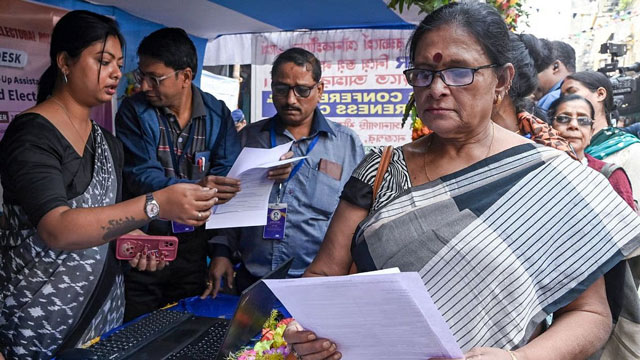
Bengaluru/New Delhi, Aug 22: As Karnataka gears up to publish its draft electoral rolls on August 24, as many as 43.80 lac voters will receive notices seeking verification of their details, while more than 1.07 crore voters identified under the Absent, Shifted, Dead, Duplicate and Outstation (ASDDO) categories are proposed to be excluded from the draft electoral roll.
Of the 4.46 crore voters expected to feature in the draft rolls, the 43.80 lac notices account for 9.81% of all submitted enumeration forms.
The 43.80 lac cases comprise 23.45 lac ‘no mapping’ cases, involving voters who did not map their 2002 SIR data in their enumeration forms, and 20.35 lac anomaly cases, involving discrepancies such as mismatches in names or ages.
The notices will be generated by the respective Electoral Registration Officers (EROs) after publication of the draft rolls and delivered to voters by Booth-Level Officers (BLOs) during door-to-door visits.
Chief electoral officer, Karnataka, V Anbukkumar said, “The notice will mention the place, date and time of hearing, the nature of anomaly and the documents to be submitted for verification. The voter has to appear in person for the hearing along with the documents or upload the documents using QR code printed on the notice. The list of voters issued the notices will be displayed at the respective polling stations too.”
The notices will be issued in any two of Kannada, English, Urdu and Marathi, depending on the region.
The hearings will be conducted at the concerned polling station, gram panchayat office or other nearby government premises. Reportedly, venues could also include police stations or other government buildings located close to the respective polling stations.
Officials said voters receiving notices will have to appear before the ERO or Assistant Electoral Registration Officer (AERO) in person, even if they upload the required documents online using the QR code printed on the notice.
The voter can submit any of the 11 Election Commission-approved documents, along with Aadhaar as proof of identity. In all “no mapping” cases, the documents will be verified by the District Election Officer (DEO).
“The voter can submit any of the 11 EC-approved documents and Aadhaar (for proof of identity). The documents will be verified by the DEO in all ‘no mapping’ cases,” Anbukkumar said.
The ERO will examine the documents and information furnished by the voter before deciding whether to accept or reject the voter’s inclusion in the electoral roll.
If a voter does not attend the first hearing, a final notice for hearing will be issued. If the voter fails to appear for the second hearing as well, the name will be marked for deletion.
The ERO will issue a speaking order before generating Form 7 for deletion. The voter can appeal against the order before the DEO within 15 days of the order and before the chief electoral officer (CEO) within 30 days after the DEO’s order.
A voter whose name has been deleted can nevertheless apply for inclusion as a new voter through Form 6, subject to eligibility.
If such an application is submitted before September 23, during the Claims and Objections period, the voter can be included in the final electoral roll scheduled to be published on October 27. Applications submitted after September 23 will be processed after the completion of the SIR and included in supplementary rolls.
The ERO will declare a voter ‘ineligible’ if the person fails to satisfy any of the four criteria: being 18 years or above, a citizen of India, of sound mind and not barred by a court. Such persons cannot seek inclusion as a new voter through Form 6.
The Election Commission is also putting in place measures to document the notice-delivery and hearing process. Anbukkumar said BLOs would have to upload a photograph on their app showing delivery of the notice at the voter’s residence, along with the attendance sheet from the hearing and a group photograph of the hearing.
Given the scale of the exercise, the Commission plans to appoint additional AEROs to assist the existing election machinery.
“We have 200 EROs and will appoint AEROs to process the 43.8 lac notices within the 56-day window (August 24 to October 22). Each ERO can hear only 150 cases a day and with AEROs, the numbers could be 120 a day,” the CEO said.
During the Claims and Objections period from August 24 to September 23, first-time voters and voters marked as absent or shifted and consequently excluded from the draft rolls can seek inclusion through Form 6. Voters can also seek deletion through Form 7 or correction of details through Form 8.
Meanwhile, the more than 1.07 crore names identified under the ASDDO categories form a separate part of the electoral roll revision exercise. These include voters categorised as absent, shifted, dead, duplicate or outstation, whose entries are proposed to be removed from the draft electoral roll.
The ground-level verification will be carried out by BLOs, who will serve notices and collect information, while EROs and AEROs will conduct hearings and take decisions based on the documents and information submitted by voters.
Bengaluru bears the biggest burden
The largest concentration of verification notices is in Bengaluru. BBMP North recorded 1,66,645 anomalies and 4,46,358 cases with no mapping, taking the total number of notices to 6,13,003, or 47.89% of the notices.
BBMP Central recorded 1,55,477 anomalies and 2,73,887 cases with no mapping, with a total of 4,29,364 notices, accounting for 41.72%.
Bangalore Urban recorded 1,89,366 anomalies and 7,56,632 cases with no mapping, taking the total to 9,45,998 notices, or 41.07%.
BBMP South recorded 1,12,683 anomalies and 3,04,942 cases with no mapping, with a total of 4,17,625 notices, accounting for 38.43%.
Kodagu recorded 35,810 anomalies and 23,083 cases with no mapping, with a total of 58,893 notices, or 14.51%.
Kolar recorded 1,05,501 anomalies and 36,696 cases with no mapping, taking the total to 1,42,197 notices, or 12.65%.
Mandya recorded 1,30,986 anomalies and 19,285 cases with no mapping, with a total of 1,50,271 notices, accounting for 10.67%.
Chikkamagaluru recorded 78,726 anomalies and 12,894 cases with no mapping, taking the total to 91,620 notices, or 10.61%.
Udupi recorded 65,798 anomalies and 31,903 cases with no mapping, with a total of 97,701 notices, accounting for 9.76%.
Dakshina Kannada recorded 98,043 anomalies and 52,109 cases with no mapping, taking the total to 1,50,152 notices, or 9.12%.Chamarajanagar and Davangere have fewer than 8,000 notices each.
With the draft rolls due on August 24 and the Claims and Objections period beginning the same day, voters receiving verification notices will have to closely follow the hearing schedule and ensure that the required documents are submitted within the prescribed process to safeguard their inclusion in the electoral roll.
Photos