


Dipke returns to lead CJP protest as thousands call for Pradhan's resignation over NEET controversy
07:52PM Sat 6 Jun, 2026
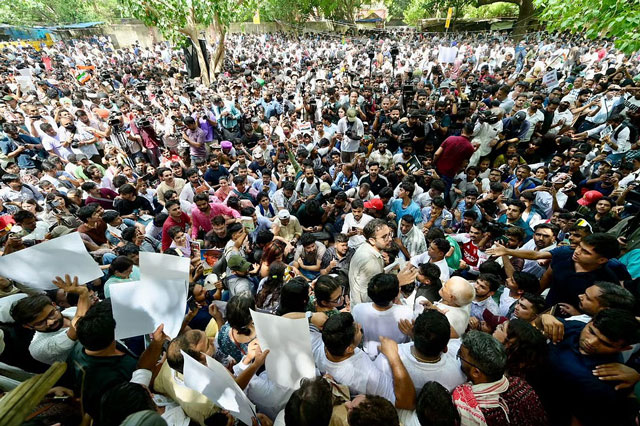
New Delhi, Jun 6: Cockroach Janta Party (CJP) founder Abhijeet Dipke returned to India on Friday and launched a major protest at Delhi's Jantar Mantar, drawing hundreds of supporters from across the country in a demonstration centred on alleged irregularities in examinations and recruitment processes.
Held under heavy security deployment, the protest brought together school and college students, young professionals, parents and education activists. Many participants wore cockroach masks and carried flowers, following calls from organisers to keep the movement peaceful and within the framework of the Constitution.
Dipke, who arrived in Delhi from the United States earlier in the day, addressed supporters and renewed his demand for the resignation of Union Education Minister Dharmendra Pradhan over the NEET paper leak controversy, alleged irregularities linked to CBSE's on-screen marking system and other examination-related issues.
"My friends, this is a long struggle. It has been a month since we started demanding Pradhan's resignation on social media, but these individuals are so shameless that instead of taking action, they have been focused on other distractions, like hacking our accounts and getting our posts deleted. You may be able to delete our posts, but you cannot erase us from this space," Dipke said during his address.
The protest marked the most significant offline mobilisation yet by the CJP, which began as a satirical online movement but has increasingly transformed into a grassroots campaign driven by concerns over educational accountability and student welfare.
Supporters travelled from several states to attend the gathering. Among them was 26-year-old Ravi Kumar from Bihar, who came to Delhi with his younger sister, a NEET aspirant who has spent the last two years preparing for the examination.
"Watching her hard work be met with controversy has been frustrating. We're not going there to create trouble. We just want our concerns to be heard," Kumar said.
Sahil, a student from West Bengal, travelled to the capital with 50 others who funded their own journeys.
"I hope our protest is successful. This protest is to save our education system and demand the resignation of the Education Minister," he said.
Apart from seeking Pradhan's resignation, protesters highlighted a range of concerns affecting students and families across the country. One of the key demands was that further digitalisation of education should only be implemented after proper assessment and teacher training.
"We are digitalising everything from banking to education, but are we able to stop the wrong practices? The answer is no. There is rampant bank fraud, and now we are seeing the impact of digitalisation in the education space. I am not against it, but introduce it only after proper assessment and training of teachers," said Radheshyam Kaithal, a 50-year-old father of three students pursuing higher education in Delhi.
Participants also drew attention to the continuing disruption of education in Manipur.
"There's unrest in Manipur since the past three years. Nothing in my state functions in a normal way, including schools and colleges. Students are under so much distress there," said Winson, a 32-year-old social entrepreneur who left the state two years ago and now works in Noida.
Concerns over the credibility of competitive examinations were another major theme of the protest. Several attendees spoke about the impact of alleged paper leaks on students who had spent years preparing for entrance tests.
"My cousin was preparing for NEET away from family and in a tiny room in Kota. He was hopeful that even if he got admission to a low-ranking college, he would take it. But then the leak happened. He has been preparing for over three years. We don't know how to motivate him to appear for the paper again," said Gayathri Singh, a 34-year-old resident of Delhi originally from Jaipur.
For many young supporters, the movement represents more than a reaction to examination controversies. They view it as a platform for raising broader concerns that they believe are being overlooked by mainstream politics and media.
An MBA student from Delhi, who identified himself as Fateyjoote, said the movement had given young people a way to channel growing frustration.
"Our generation is very angry," he said, citing issues ranging from hospital conditions to poor civic infrastructure. "The anger was already there, but now we know how to channel it. Even those not personally affected by the exams are joining to seek justice for the next generation."
Others said they were drawn to the protest because it focused on issues directly affecting students and parents.
"I have been following the party online, but wasn't sure if I should come for the protest or not. I was on my way to the office at 10 am in Rohini, but suddenly I decided to just come and check," said 18-year-old Ronak Kumar.
"I don't know about the party's future, but for now at least they are talking about issues that matter to everyone—whether you are a student or a parent worrying about the education of your children."
Mental health and accountability also featured prominently in the discussions at the protest site.
"The CJP movement has been able to bring people from social media to the ground, which means they are talking about issues that people somewhere relate to. Some students have ended their lives and lakhs are under constant mental pressure, and there's no accountability," said Sugandha, a 38-year-old psychologist.
Ahead of the demonstration, Dipke had released video appeals across CJP's social media platforms urging supporters from across India to gather in Delhi. The party's website stated that organisers would seek permission for a peaceful protest before assembling at Jantar Mantar.
On June 3, organisers announced that activist Sonam Wangchuk would join the movement. Both Wangchuk and Dipke repeatedly emphasised that the protest should remain peaceful.
"This movement will be led with love and peace," Dipke wrote beneath an Instagram reel in which Wangchuk encouraged supporters to bring flowers.
Organisers had initially planned for supporters to greet Dipke at Indira Gandhi International Airport upon his arrival. However, the proposal was later withdrawn after Dipke said he did not want to inconvenience passengers.
In a separate video appeal, Dipke urged supporters to take ownership of the movement.
"How long will we wait for someone else to come, raise their voice and save us?" he asked, calling on those who believe in democracy to unite for the future of Indian students.
Among those gathered was a participant from Hapur in Uttar Pradesh, who described the sacrifices made by students travelling long distances to attend the protest.
"We left our house at 5 pm yesterday. We have spent the whole night here," he said.
Rejecting suggestions of political affiliation, he added: "We are not from any party. We are students from different places."
According to the attendee, all members of his group had appeared for the NEET examinations in 2024 and 2026 and were motivated to join the protest after both papers were allegedly leaked.
As slogans demanding accountability echoed across Jantar Mantar, the demonstration reflected growing frustration among students and parents who say examination controversies, recruitment irregularities and a lack of institutional accountability have undermined confidence in India's education system.
Photos